
How to Train for a Marathon Without Getting Injured: Expert Tips from a Running Coach and Physical Therapist

Training for a marathon is one of the most rewarding challenges a runner can take on. But for many runners, the journey to the starting line is filled with setbacks, nagging injuries, and the fear of hitting the wall before reaching the finish line.
The good news? It doesn’t have to be that way.
In this episode of the Healthy Runner Podcast, I sat down with marathon coach Jason Fitzgerald, founder of Strength Running, USATF-certified coach, and 2:39 marathoner, to answer the biggest questions runners have about marathon training.
Together, we combine the coaching perspective with the physical therapy perspective to help you train smarter, stay healthy, and run your strongest marathon yet.
How to Train for a Marathon Without Getting Injured: PT & Running Coach Answer Your Questions
Why Do So Many Marathon Runners Hit the Wall?
One of the biggest fears marathon runners have is slowing dramatically during the final 10K.
While nutrition certainly plays a role, Jason explains that hitting the wall often starts months before race day.
Common training mistakes include:
-Not building enough easy aerobic mileage
-Long runs that lack progression and specificity
-Trying to make up for missed training late in the training cycle
-Inconsistent weekly mileage
As a physical therapist, I often see what happens when fatigue takes over.
Late in the marathon, hip strength begins to decline, stride mechanics become less efficient, and runners compensate with poor movement patterns. Those changes don’t just slow you down, they can also increase your risk of injury.
The best way to avoid the wall is to build the fitness that allows you to maintain good running mechanics even when fatigue sets in.
The Marathon Workouts That Actually Matter
Many runners spend too much time worrying about finding the “perfect” workout.
In reality, successful marathon training is built on consistently executing a few key sessions.
According to Jason, every marathon training plan should include:
-Consistent easy running to build aerobic fitness
-Weekly long runs to improve endurance
-Threshold workouts to raise your lactate threshold
-Appropriate recovery between hard efforts
Each workout serves a different purpose.
Trying to turn every run into a hard effort simply creates more fatigue while limiting adaptation.
Why Easy Runs Should Actually Feel Easy
This is one of the most common mistakes we see.
Many runners run their easy days too fast.
Easy running isn’t about proving your fitness.
It’s about allowing your body to recover while continuing to build your aerobic engine.
From a physical therapy standpoint, easy runs also reduce repetitive stress on muscles, tendons, and joints.
When every run becomes moderately hard, your recovery suffers.
Eventually, your quality workouts decline, your long runs become more difficult, and your injury risk increases.
Running slower on easy days often leads to faster marathon performances.
How to Structure Your Long Runs
Long runs remain one of the most important parts of marathon training.
However, longer isn’t always better.
Jason discusses several ways to structure long runs depending on where you are in your training cycle:
-Comfortable steady long runs
-Progression long runs
-Marathon pace segments
-Fast finish long runs
Each variation develops different physiological adaptations.
As your race approaches, specificity becomes increasingly important.
From an injury prevention standpoint, avoid making every long run a race simulation.
Running too fast for too long every weekend often leads to excessive fatigue, delayed recovery, and overuse injuries.
Your long runs should prepare you for race day—not leave you feeling like you just raced every Saturday.
Zone 2 vs. Threshold Training
Zone 2 has become one of the hottest topics in endurance sports.
While easy aerobic running is incredibly valuable, Jason reminds runners that marathon performance requires more than simply logging slow miles.
Successful marathon training balances:
-Easy aerobic running
-Threshold workouts
-Marathon pace training
-Recovery
Most runners don’t need more hard workouts.
They need to run their easy days easier so they can execute their quality sessions at a higher level.
Why Strength Training Is Essential for Marathon Runners
One of the biggest questions I receive is:
“Should I stop lifting while training for a marathon?”
My answer is almost always no.
Strength training isn’t just about getting stronger.
It’s about improving your body’s ability to tolerate the demands of marathon training.
A well-designed strength program can help:
-Improve single-leg stability
-Build stronger tendons
-Increase hip and glute strength
-Improve running economy
-Reduce injury risk
Jason also shares how strength training can be scheduled around your running workouts so you continue progressing without compromising recovery.
The goal isn’t to become a powerlifter.
The goal is to become a more resilient runner.
Marathon Training for Runners Over 40
As runners age, training doesn’t necessarily become easier—but it does become smarter.
Masters runners often benefit from:
-Prioritizing sleep and recovery
-Allowing more recovery between harder sessions
-Strength training consistently
-Monitoring small aches before they become major injuries
-Building training gradually
Many generic marathon plans fail to account for these differences.
That’s why personalization becomes increasingly important as we get older.
The right plan isn’t simply the one with the most miles.
It’s the one your body can consistently recover from.
The Biggest Marathon Training Mistakes
When we wrapped up the conversation, Jason and I each shared the one thing we’d change about how most recreational marathoners train.
Jason’s answer:
Stop running your easy runs too hard.
My answer:
Stop ignoring the early warning signs your body is giving you.
Small aches rarely appear overnight.
Most injuries begin with subtle changes in soreness, stiffness, or recovery that are easy to dismiss until they become significant problems.
Listening to those signals early often allows you to make small adjustments instead of dealing with weeks or months away from running.
Final Thoughts
Training for a marathon isn’t about finding the perfect workout.
It’s about consistently executing the fundamentals.
Build your aerobic base.
Respect your easy days.
Train with purpose.
Strength train consistently.
Recover just as intentionally as you train.
And most importantly, choose a marathon training plan that fits your life—not someone else’s.
By combining smart coaching principles with injury prevention strategies, you’ll give yourself the best chance to arrive at the starting line healthy, confident, and ready to perform your best.
🎁 Free Resource: Marathon Training Guide
Want a clear, proven roadmap to train smarter and feel strong on race day?
Ultimate Marathon Training Guide to Master Your Marathon Feeling Strong
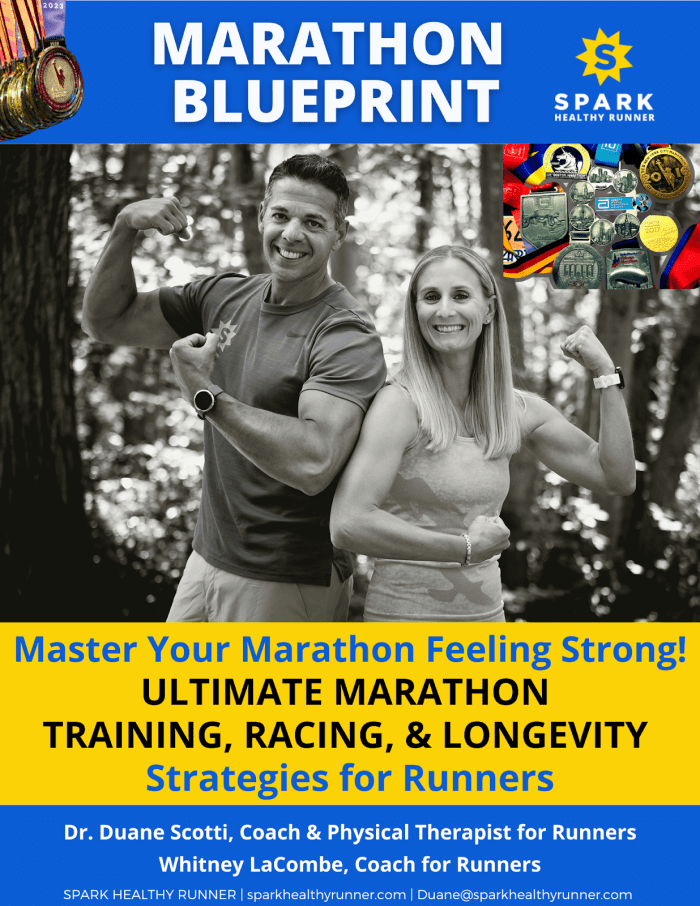
Inside, you’ll learn:
-How to choose the right training plan
-How to balance strength training with running
-Nutrition and recovery strategies
-Common mistakes to avoid
-Race day strategy and travel tips
Claim your free copy here!
If you’re ready to train smarter and finally feel strong and confident in your running again, join the Healthy Runner Academy.
This membership is designed for adult runners who want to run pain-free, build strength, and stay consistent — for life.
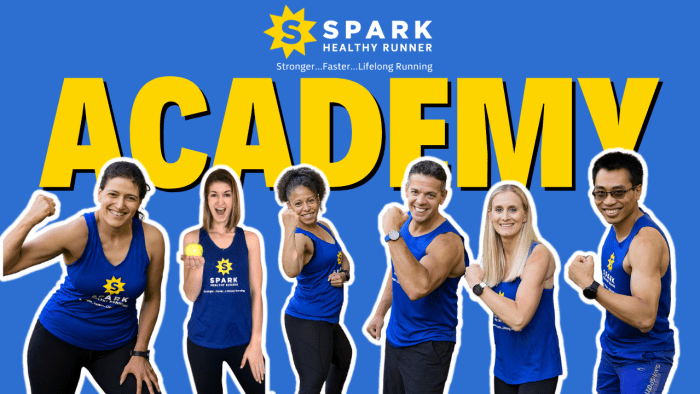
The Healthy Runner Academy provides you the step-by-step system to finally stay consistent, avoid burnout, and prevent nagging injuries — all with expert coaching and a supportive community behind you.
Perfect for adult runners who want to:
– Stop nagging injuries
– Build a resilient running body
– Get faster and stronger
– Enjoy pain-free, consistent training
Click here to join the waitlist today and be first in line when doors open (only 3x/year) + get a special bonus to reset your running journey!
Looking for 1-on-1 guidance, structure, support, and accountability? Check out our signature Spark Healthy Runner Coaching here!
Watch how Francisco not only broke through his plateau but qualified for the Boston marathon at age 57
Watch how Joe beat knee pain & crushed his first marathon at the Marine Corps!

A big thanks to CurraNz for your support for this episode!

Want to know my favorite recovery supplement for runners? CurraNz is New Zealand’s natural running supplement made of a strong antioxidant (polyphenol anthocyanin) found within blackcurrants.
Backed by more than 70 studies benefitting recovery and performance, CurraNz helps improve blood flow and has been my go to training partner in my personal running journey and recommend to the athletes in our program!
Learn more about the real science behind blackcurrant extract in my interview with Fleur Cushman in episode 233 on the Healthy Runner Podcast.
Click here and use code HEALTHYRUNNER for 20% off your first order!

Listen to my previous episode about building mental resilience for running with Jason

Listen to my previous episode about injury prevention with Jason

Listen to my previous episode with Jason about Strength Training as Power Training for running here!
There are six parts of your running journey that need to be optimized so you can run strong and last long! Learn them here.
Want Dr. Duane to answer your question on the podcast? Submit your running and health questions here

Jason Fitzgerald is a USA Track & Field certified coach, host of the Strength Running Podcast, and the founder of Strength Running – an award-winning blog with hundreds of thousands of monthly readers.
A collegiate runner at Connecticut College, he finished Top 10 in the 2006 New England 3,000m Steeplechase final and was a member of the 2002 National Championship-qualifying cross country team.
A 2:39 marathoner, he won the 2011 Morraine Hills Half Marathon, the 2012 Maryland Warrior Dash obstacle race, and the 2013 Potomac River Run Marathon.
Jason is Men’s Running Magazine’s 2017 Influencer of the Year, a member of Greatist’s Expert Network, and has been published in Runner’s World, Business Insider, Forbes, Health Magazine, The Washington Post, Podium Runner, The Huffington Post, and many other major media.
More importantly, he has helped tens of thousands of runners just like you accomplish their wildest running goals.
Connect with Jason:
– Get Jason’s free series on mindset training for runners
– Learn more about Jason and Strength Running
– Follow Jason on Instagram
– Watch Strength Running videos on YouTube
– Listen to the Strength Running podcast
Get my full personal running story here

There are six parts of your running journey that need to be optimized so you can run strong and last long! Learn them here.
Want these to land in your inbox each and every week so you can learn how to become a stronger, faster, lifelong injury free runner?

Subscribe to my weekly newsletter here!
Thanks for reading!
Yours in health,
Duane
Connect with Dr. Duane:

Dr. Duane Scotti, DPT, PhD, OCS is a running physical therapist, run coach, host of the Healthy Runner podcast, and founder of Spark Healthy Runner and has been a leader in the rehab and running community for 20+ years.
Duane initially started running as an adult, wanting to add some cardio to his gym sessions. After having hip surgery, his doctor advised him to get off the treadmill and run outside. Without having fully recovered, Duane suffered his first running-related hamstring tendon injury and many others as a novice runner early on.
As a coach, he has guided thousands of athletes back to running, finishing their first marathon, crushing a personal best, and even the elusive Boston Marathon qualifying time.
After 19 years teaching in higher education, Duane decided to step away as a Clinical Associate Professor of Physical Therapy to pursue his passion educating the running community. Through his signature 1:1 coaching program, Healthy Runner Academy membership, weekly videos, and podcast episodes, he empowers runners to get stronger, run faster, and enjoy lifelong injury free running without having to stop running to get over an injury. Dr. Duane truly believes that anyone can run and that all runners should be treated differently when recovering from an injury. He is on a mission to change the traditional thinking that running causes “overuse injuries” or “your body is just not meant to run” and you must “take a break” to get better. Through strength and run specific training you can grow a strong mind, strong body, and just keep running!
Duane received his Bachelor of Health Science degree and Master of Physical Therapy degree from Quinnipiac University in 2001 and 2003. He then went on to receive a clinical Doctor of Physical Therapy and a Ph.D. in Physical Therapy from Nova Southeastern University in 2017. Duane is a board-certified Orthopaedic Clinical Specialist, RRCA Certified Running Coach, Certified Mulligan Practitioner, certified in dry needling and has advanced training in spinal manipulation and rehabilitation for runners.
As an athlete, Duane is an adult-onset runner, 6x marathoner, avid half marathoner, and enjoys challenging himself to learn and grow in his personal running journey!
A native New Yorker from Long Island, Duane currently lives in Cheshire, Connecticut with his wife Deb and his two teenage daughters who are competitive volleyball players. They all love to explore new beaches along the east coast.
Get weekly running tips on the Healthy Runner Podcast…available wherever you get your podcasts!


Related posts
Learn how to train for a marathon without getting injured. Dr. Duane Scotti and Jason Fitzgerald share expert tips on long runs, strength training, Zone 2, and avoiding the wall.Read More

Learn how to carb load before a marathon, including what to eat, when to start, how many carbs you need, and common mistakes that can lead to bonking.Read More

Learn how to treat and prevent 3 common marathon injuries—IT band syndrome, Achilles tendinopathy, and hamstring pain—so you can keep running strong.Read More

“I don’t have enough words to express my gratitude towards Duane Scotti and the Spark Healthy Runner program. When I started working with Duane, I had been dealing with chronic shin splints/posterior tibialis tendinitis for almost a year.
I had worked with multiple other coaches and physical therapists with little success and was at the point of almost giving up on my love for running. Duane is so kind, thoughtful and knowledgeable as both a physical therapist and running coach. Our first virtual meeting lasted two hours because he was so meticulous in his assessment. His strength and running program is progressive and created so that you can continue to build strength and mileage as you heal. His strength program is unique, effective, and fun.
Additionally, his warm-up routine is awesome and includes drills that over time have made me a more efficient runner. His training platform is easy to use, and he is always readily available to chat when problems or questions arise.
Over four months of working with Duane, I have built back to five days a week of running and am almost back up to my pre-injury weekly mileage and long run distance. Whenever I have flare ups or setbacks, Duane reassures me and makes necessary adjustments so that I can continue to progress in my running journey. I have had so much success with him so far that I have signed on for four more months so that he can help me to continue getting stronger as I train for the Dopey challenge in Disney World.
If you are struggling with a running injury and are feeling hopeless, you have to reach out to Duane Scotti. Of course, you will have to put in a lot of hard work, but with Duane by your side, you will be able to achieve your goals and more. Thank you Spark Healthy Runner for bringing the spark back to my running!”

You can teach an old dog new tricks!!! I have never considered myself a runner and I knew I needed to be smart about it because I am no spring chicken. Spark preached getting strong and healthy to be injury free and they practice what they preach. I am soooo glad I made the investment in me! I finished my half marathon last weekend and couldn’t be any happier! The program fed me all the steps I needed to essentially learn how to run long distance, build strength, nutrition help, a forum of other runners and probably most important was the 1:1 coaching. I had no idea how to tackle training for a 1/2 marathon and this program broke all of it down, had it individualized for me and we tweaked as we went to make sure I was staying healthy and strong. I had so many questions the week prior to my race and Coach Cat was always there for me and answering all the questions and issues I had-and believe me there were a lot! The biggest benefit I think I got was the strength. I am strong and fit. But most important was what I gained emotionally. I built confidence and strength I didn’t know I had, even at my age. Honestly could not have done this without Spark Healthy Runners!

My Healthy Runner journey started after I had battled bilateral achilles pain for a few months and was frustrated how it affected my running. As soon as I talked to Duane I knew I had made the right decision. His positivity, enthusiasm and genuine care are infectious. The training plan that was tailored to me included specific exercises to rehab my injury and I was so excited that I didn’t have to stop running. It took patience to only run slow for a few weeks but I trusted the process and it got me me to where I am now: running pain free. We made adjustments to the plan throughout whenever needed having someone in your corner that is always there with guidance and support throughout the process was invaluable.
I just ran my second half marathon, both with Duane’s coaching, and PR’d by over 9 minutes! I got all choked up in the last mile when I realized that I felt strong and could still kick it up a notch.
I’m so thankful for the Healthy Runner program, community and the entire coaching team for all the support!