
Marathon Travel and Recovery Tips: How to Prepare for a Destination Race
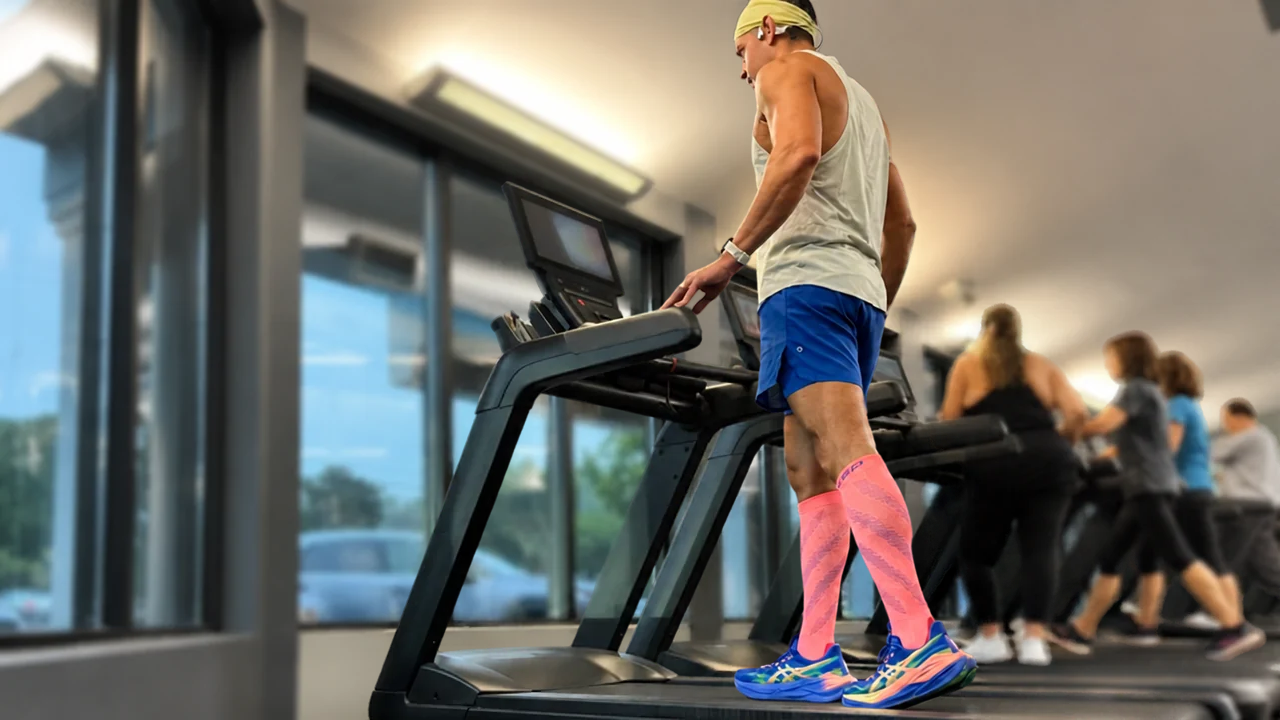
Traveling for a marathon? You’ve spent months preparing for race day. You’ve completed your long runs, dialed in your fueling, stayed consistent with strength training, and worked hard to get your body ready for 26.2 miles.
But here’s something many runners overlook…
Your marathon preparation doesn’t end when you finish your last training run!
Long flights, hours in the car, poor sleep, excessive walking, and disrupted routines can leave your legs feeling heavy before you even reach the starting line.
And what happens AFTER you cross that finish line is just as important!
Whether you’re traveling to the NYC Marathon, Philadelphia Marathon, Indianapolis Monumental Marathon, or Disney Marathon Weekend, having a smart marathon travel and recovery plan can help you arrive feeling fresh, race strong, and recover better.
As a physical therapist, running coach, and 9-time marathoner, I’m sharing my favorite evidence-informed strategies to help you prepare for your next destination race.
We’ll also dive into what the science actually says about compression socks for runners, including how they support circulation, what they can do for swelling during travel, and whether they really help with post-marathon recovery.
Because the goal isn’t just to finish your next marathon.
It’s to stay healthy, get stronger, and enjoy lifelong running!
Marathon Travel & Recovery Tips: What to Do Before and After Your Race
1. Why Marathon Travel Can Leave Your Legs Feeling Heavy
Let’s start with a question.
When does your marathon weekend actually begin?
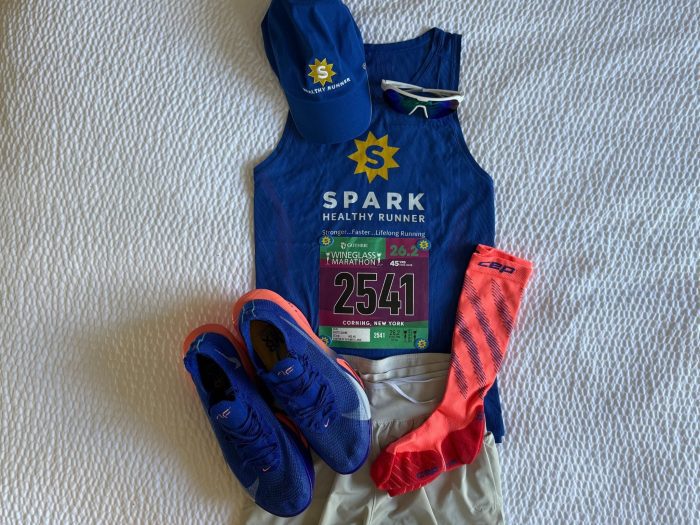
When you pick up your race bib? When you lay out your gear the night before? Or when you step up to the starting line?
I would argue that your race weekend begins the moment you leave your house!
Travel day is part of your marathon preparation.
Think about what happens when you’re traveling to a destination race.
You might spend five hours sitting in a car, several hours on a plane, or an entire day navigating airports and transportation.
Even though you’re not running, your body is still dealing with additional stress.
And here’s something I remind the runners we coach all the time:
Your body doesn’t just respond to training stress. It responds to ALL stress.
That includes travel, disrupted sleep, long days on your feet, and changes to your normal routine.
What happens to your circulation when you sit for too long?
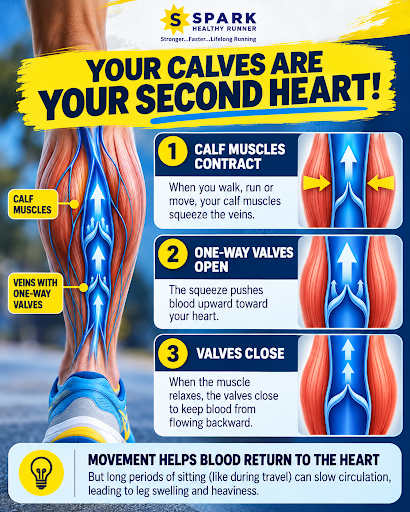
Your calf muscles play an important role in helping blood return from your lower legs toward your heart.
We call this the calf muscle pump.
Every time you walk or contract your calf muscles, those contractions help move blood through your veins.
But when you’re sitting for extended periods, your calf muscles aren’t working as frequently.
This can contribute to fluid pooling in your lower legs, especially during prolonged travel.
That’s one reason runners may notice:
-Heavy or tired legs after flying
-Swollen ankles or feet
-Stiff calves after long car rides
-General lower-leg discomfort after sitting
Now, this doesn’t mean traveling is going to ruin your marathon.
But it does mean we should be intentional about keeping our legs moving!
Simple ways to support circulation while traveling
Whether you’re flying or driving, here are a few easy strategies:
Get up and walk periodically. Take movement breaks during long car rides or walk around the airplane cabin when it’s safe.
Perform ankle pumps. Pull your toes toward your shins, then point them away to activate your lower-leg muscles.
Try seated calf raises. Lift your heels while keeping your toes on the floor.
Avoid staying in one position for hours. Change positions and move your legs regularly.
You don’t need a complicated mobility routine.
Sometimes the simplest strategies are the most practical!
2. Compression Socks for Marathon Travel: What Does the Science Say?
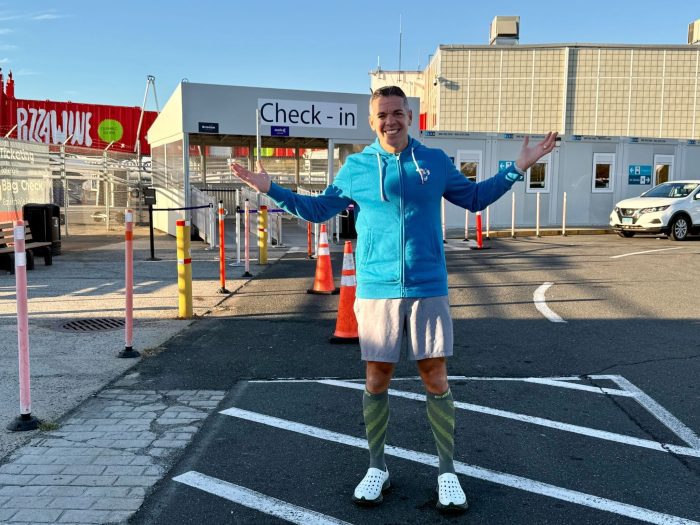
Let’s talk about something I personally use when traveling to races.
Graduated compression socks! 🧦
You’ve probably seen runners wearing compression socks during races, on airplanes, or after long runs.
But do they actually work?
And what does the research say?
As a physical therapist, I want you to understand WHY a recovery tool may be helpful rather than simply using something because another runner recommends it.
How do graduated compression socks work?
Your arteries carry blood away from your heart, while your veins return blood toward your heart.
When you’re standing or sitting, blood returning from your lower legs must work against gravity.
Graduated compression socks apply external pressure to your lower legs.
The pressure is generally greatest near the ankle and gradually decreases higher up the leg.
This helps support venous return and can reduce fluid accumulation in the lower extremities.
Think of compression as a way to provide additional support to your circulatory system, particularly when you’re sitting for extended periods.
Do compression socks help during long flights?
Here’s where the research is encouraging.
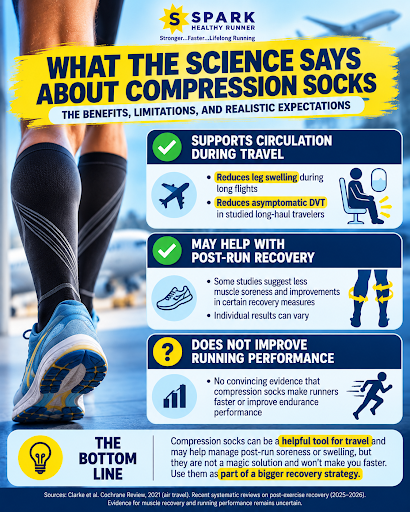
A 2021 Cochrane systematic review examined 12 randomized trials involving nearly 3,000 airline passengers.
Researchers found that wearing compression stockings during long flights reduced asymptomatic deep vein thrombosis (DVT) and helped reduce lower-leg swelling.
That’s meaningful evidence for travelers who spend several hours sitting on an airplane.
However, it’s important to understand that these studies were not specifically conducted on marathon runners, and they did not establish a reduction in symptomatic blood clots or an improvement in race performance.
The takeaway: Properly fitted graduated compression socks can be a useful option for managing leg swelling during prolonged travel.
Do compression socks improve post-run recovery?
Now this is where things get a little more complicated.
Some studies suggest compression garments may reduce perceived muscle soreness or improve certain recovery measures following exercise.
However, the evidence is mixed, particularly when it comes to endurance performance and recovery after long-distance running.
We cannot confidently say that wearing compression socks after a marathon will speed muscle tissue repair or help you run faster in your next race.
And that’s an important distinction!
Compression is a recovery TOOL. It’s not a replacement for recovery.
I personally find compression socks helpful during travel and after long runs, particularly when my legs feel heavy.
Some runners I coach also report feeling more comfortable using compression.
But individual experiences aren’t proof that compression treats running injuries or improves performance.
If you choose to wear compression socks, make sure they fit properly and follow the manufacturer’s instructions.
And if you have a history of blood clots or significant circulation problems, talk with your healthcare provider about what’s appropriate for you.
Remember, compression doesn’t replace movement during travel. New one-sided leg swelling or pain should not automatically be dismissed as routine post-race soreness, and sudden chest pain or shortness of breath requires emergency medical attention.
3. Avoid This Common Destination Marathon Mistake: Too Much Walking!
You’ve arrived at your destination.
You’re excited!
Maybe you’re in New York City, Chicago, Boston, or Disney World.
You want to explore, visit the race expo, take photos, and soak up the entire experience.
I completely understand!
But here’s one of the biggest mistakes I see destination marathon runners make.
They turn the day before their marathon into a sightseeing marathon!
Before they know it, they’ve walked 20,000 steps.
And now they’re wondering why their legs feel tired before the race even begins.
Remember, the purpose of your marathon taper is to reduce accumulated fatigue while maintaining the fitness you’ve worked so hard to build.
Adding hours of extra walking during race weekend may work against that goal.
How to protect your legs before race day
You can absolutely enjoy your destination race experience.
Just be intentional.
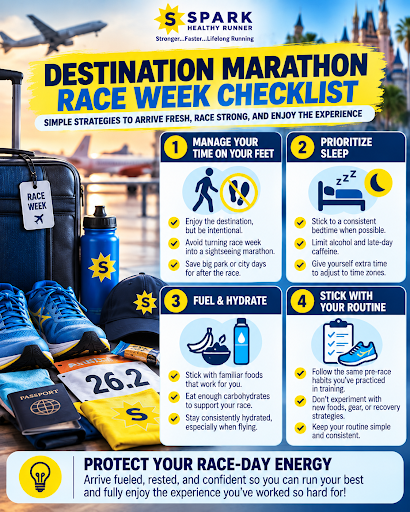
-Plan your race expo visit so you’re not wandering around for hours.
-Limit unnecessary walking the day before your marathon.
-Use transportation when it makes sense.
-Consider saving major sightseeing activities until after the race.
-Take breaks and get off your feet when possible.
This is especially important for runners heading to Disney Marathon Weekend!
I love the Disney magic just as much as anyone.
But remember, you don’t need to spend an entire day walking around Magic Kingdom before running 26.2 miles!
Protect your race-day energy. You’ve already done the hard work.
4. Prioritize Sleep, Fueling, and Hydration During Race Week
Let’s talk about three recovery strategies that matter much more than expensive gadgets.
Sleep.
Fueling.
Hydration.
These are the foundations of your marathon preparation and recovery.
Sleep: One of your most powerful recovery tools
Traveling can disrupt your normal sleep routine.
Maybe you’re sleeping in an unfamiliar hotel room.
Maybe you’ve crossed time zones.
Or maybe you’re nervous about race day.
The night before a marathon isn’t always your best night of sleep, and that’s okay!
Instead of putting all the pressure on that one night, prioritize consistent sleep throughout race week.
Aim for approximately 7–9 hours per night, recognizing that individual sleep needs vary.
A few strategies that may help include:
-Keeping a consistent bedtime and wake time
-Limiting alcohol
-Being mindful of late-day caffeine
-Using a sleep mask or earplugs
-Keeping your hotel room cool and dark
-Allowing time to adjust to a new time zone when possible
You don’t need perfect sleep.
You need habits that support recovery.
Fueling: Don’t experiment on race weekend!
You’ve spent months practicing your race-day nutrition strategy.
Now is not the time to change everything!
Stick with familiar foods and follow your practiced carbohydrate-loading plan.
Bring snacks when traveling so you’re not relying entirely on airport or convenience-store options.
And make sure you’re eating enough to support your race.
Hydration: Be consistent, not excessive
Travel can make it easy to forget about hydration.
Carry a water bottle, drink regularly, and consider your individual fluid and sodium needs.
But remember, drinking excessive amounts of water isn’t beneficial and can be dangerous.
The goal is to arrive at your race adequately hydrated, not to force as much water as possible.
5. What Should You Do 24 Hours Before Your Marathon?
Now we’re getting close to race day!
And this is where runners often start overthinking everything.
Should you stretch?
Foam roll?
Wear compression socks?
Go for a shakeout run?
Here’s what I want you to remember:
The final 24 hours are not about gaining fitness. They’re about protecting the fitness you’ve already built.
If your training plan includes a short shakeout run, that’s fine.
If your plan calls for rest, that’s fine too!
A little gentle walking, light mobility, or familiar foam rolling may help you feel comfortable.
But avoid introducing aggressive stretching, deep tissue massage, or unfamiliar recovery techniques right before your race.
Race week is not the time to experiment!
Focus on what you can control:
-Familiar meals and hydration
-Your practiced pre-race routine
-Race-day transportation
-Preparing your gear
-Getting adequate rest
-Managing unnecessary stress
And remember, you don’t have to feel absolutely amazing every minute of race week to have a great marathon.
Trust your training!
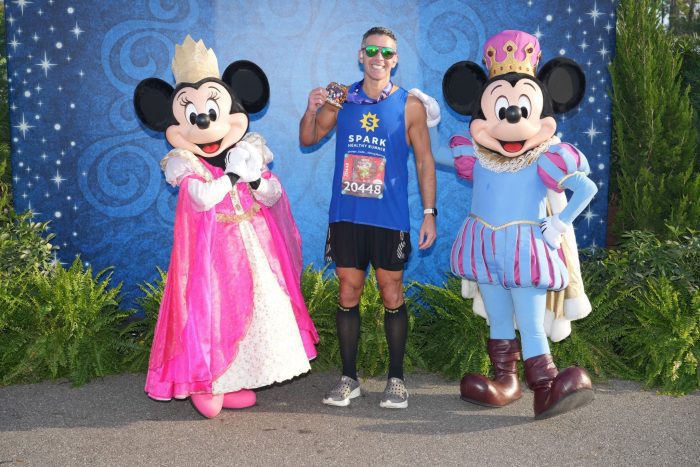
6. Post-Marathon Recovery: What to Do After Crossing the Finish Line
You did it!
You crossed the finish line!
Maybe you ran a personal best.
Maybe you completed your first marathon.
Or maybe race day didn’t go exactly as planned.
Regardless, you just asked your body to cover 26.2 miles.
That’s something worth celebrating!
But here’s something I want you to remember.
Marathon recovery doesn’t begin when you get home. It begins when you cross the finish line.
Keep moving gently after your race
I know the last thing you probably want to do after running a marathon is walk another step!
But gentle movement as tolerated can help you transition from running to recovery.
Walk through the finish chute, collect your medal, and gradually slow down.
You don’t need to walk for miles.
Just avoid immediately becoming completely sedentary if you’re feeling well enough to move.
Replenish carbohydrates, protein, and fluids
Running a marathon places significant demands on your body’s energy stores.
Carbohydrates help replenish glycogen.
Protein supports muscle repair and adaptation.
And fluids help replace sweat losses.
You don’t need an expensive recovery shake.
A familiar meal or snack containing carbohydrates and protein can be a great place to start.
If your stomach feels unsettled after the race, begin with something you can tolerate and gradually return to your normal eating routine.
Should you wear compression socks after a marathon?
Compression socks may help some runners feel more comfortable or manage lower-leg swelling after running.
But the research doesn’t consistently show that compression improves muscle repair or subsequent running performance.
If you’ve used them successfully during training, they may be a reasonable addition to your post-race routine.
Just remember:
Compression doesn’t replace sleep, nutrition, hydration, or appropriate rest.
Those are still your biggest recovery priorities!

7. Don’t Skip This Important Part of Recovery: Post-Race Reflection
Here’s something I’ve learned after completing nine marathons.
Every race has something to teach you.
Whether you run a personal best, struggle through the final miles, or don’t finish the race at all.
There’s always an opportunity to learn.
After my recent Wineglass Marathon, I took time to reflect on my performance.
I finished in 3:42:42, just two minutes and four seconds away from my marathon PR!
I could have focused entirely on those two minutes.
What could I have done differently?
Where could I have run faster?
But when I looked at the bigger picture, I realized how much I had accomplished.
At 46 years old, I ran my second-fastest marathon and achieved an age-graded marathon PR!
And I learned valuable lessons that I can carry into future training cycles.
That’s why I encourage every runner to take time to reflect after a race.
Not just on your finish time.
But on your preparation, execution, challenges, and accomplishments.
🎁 FREE Post-Race Reflection Worksheet
I created a FREE Post-Race Reflection Worksheet to help you learn from every race and become a stronger, more confident runner.
Inside, you’ll discover five important questions to ask yourself after your next 5K, half marathon, or marathon.
👉🏼 Download Your FREE Post-Race Reflection Worksheet
And if you want to learn more about the five questions I personally ask after every race, check out:
Episode 311: 5 Questions You MUST Ask After Every Race (Most Runners Don’t)
Because becoming a stronger runner isn’t just about running more miles.
It’s about learning from the miles you’ve already run!
8. How to Recover When Traveling Home After a Marathon
There’s one final part of destination marathon recovery that runners often overlook.
Getting home!
You’ve just run 26.2 miles.
Your legs are sore.
Your feet may be swollen.
And now you’re about to spend several hours sitting in an airplane or car.
Not exactly the ideal situation!
If possible, consider giving yourself some additional recovery time before a long trip home.
But if you need to travel shortly after your race, here are a few things to remember.
Keep moving. Take walking breaks when possible and perform ankle pumps during prolonged sitting.
Pack recovery snacks. Make sure you have access to carbohydrates, protein, and fluids.
Consider compression socks. Properly fitted graduated compression socks may help manage swelling during prolonged travel.
Prioritize sleep. Give your body the opportunity to recover from the physical demands of the race.
Don’t rush back into running. Your return to training should depend on how hard you raced, your training history, and how your body is responding.
There’s no universal number of recovery days that works for every marathon runner.
The goal isn’t to return to running as quickly as possible.
The goal is to recover well enough to continue training consistently for years to come!
Your Destination Marathon Travel and Recovery Checklist
Before your next destination marathon, remember these five important strategies:
- Make travel day part of your race preparation. Plan movement breaks and avoid prolonged inactivity.
- Support your circulation. Walk, perform ankle pumps, and consider properly fitted compression socks for long flights.
- Protect your energy before race day. Limit unnecessary walking and prioritize sleep, fueling, and hydration.
- Start recovering at the finish line. Focus on gentle movement, nutrition, fluids, and rest.
- Reflect on your race. Celebrate your accomplishments and identify lessons for your next training cycle.
Remember, marathon preparation doesn’t end with your last training run.
And marathon recovery doesn’t end when you leave the finish line.
You don’t become a stronger runner simply by completing more training. You become stronger when your body has the opportunity to adapt to the training you’ve completed.
That’s why having a smart travel and recovery strategy is so important!

💪🏼 Ready to Run Stronger, Recover Smarter & Stay Healthy?
You’ve put in the miles and worked hard to prepare for race day. But staying healthy, recovering well, and running consistently takes more than just following a training plan!
Whether you’re preparing for your next destination marathon, struggling with lingering soreness, or looking to build strength so you can keep running for years to come, we’re here to help!
Find the level of support that’s right for you:
👉🏼 Healthy Runner Academy: Build a stronger running foundation with structured strength training, expert recovery education, and a supportive community to help you stay consistent and run healthy.
🏅 1:1 Healthy Runner Coaching: Get a personalized running and strength training plan, ongoing feedback, and individualized guidance to balance training and recovery so you can arrive at your next starting line feeling strong and confident.
Because the goal isn’t just to finish your next race.
It’s to stay healthy and keep running strong for years to come! 💛💙
Let’s continue to grow a strong mind, strong body, and Just Keep Running!
Research Reference
Clarke MJ, et al. (2021). Compression stockings for preventing deep vein thrombosis in airline passengers. Cochrane Database of Systematic Reviews.
https://pubmed.ncbi.nlm.nih.gov/3387820
Get my full personal running story here

There are six parts of your running journey that need to be optimized so you can run strong and last long! Learn them here.
Want these to land in your inbox each and every week so you can learn how to become a stronger, faster, lifelong injury free runner?

Subscribe to my weekly newsletter here!
Thanks for reading!
Yours in health,
Duane
Connect with Dr. Duane:

Dr. Duane Scotti, DPT, PhD, OCS is a running physical therapist, run coach, host of the Healthy Runner podcast, and founder of Spark Healthy Runner and has been a leader in the rehab and running community for 20+ years.
Duane initially started running as an adult, wanting to add some cardio to his gym sessions. After having hip surgery, his doctor advised him to get off the treadmill and run outside. Without having fully recovered, Duane suffered his first running-related hamstring tendon injury and many others as a novice runner early on.
As a coach, he has guided thousands of athletes back to running, finishing their first marathon, crushing a personal best, and even the elusive Boston Marathon qualifying time.
After 19 years teaching in higher education, Duane decided to step away as a Clinical Associate Professor of Physical Therapy to pursue his passion educating the running community. Through his signature 1:1 coaching program, Healthy Runner Academy membership, weekly videos, and podcast episodes, he empowers runners to get stronger, run faster, and enjoy lifelong injury free running without having to stop running to get over an injury. Dr. Duane truly believes that anyone can run and that all runners should be treated differently when recovering from an injury. He is on a mission to change the traditional thinking that running causes “overuse injuries” or “your body is just not meant to run” and you must “take a break” to get better. Through strength and run specific training you can grow a strong mind, strong body, and just keep running!
Duane received his Bachelor of Health Science degree and Master of Physical Therapy degree from Quinnipiac University in 2001 and 2003. He then went on to receive a clinical Doctor of Physical Therapy and a Ph.D. in Physical Therapy from Nova Southeastern University in 2017. Duane is a board-certified Orthopaedic Clinical Specialist, RRCA Certified Running Coach, Certified Mulligan Practitioner, certified in dry needling and has advanced training in spinal manipulation and rehabilitation for runners.
As an athlete, Duane is an adult-onset runner, 9x marathoner, avid half marathoner, and enjoys challenging himself to learn and grow in his personal running journey!
A native New Yorker from Long Island, Duane currently lives in Cheshire, Connecticut with his wife Deb and his two teenage daughters who are competitive volleyball players. They all love to explore new beaches along the east coast.
Get weekly running tips on the Healthy Runner Podcast…available wherever you get your podcasts!


Related posts
Discover marathon travel and recovery tips to arrive with fresh legs, race strong, and recover faster with expert advice on compression, sleep, and hydration.Read More
Learn what happened when I recorded my first marathon DNF and the key lessons on mindset, training, recovery, and resilience that followed.Read More

Struggling with burnout? Learn how easy running and enjoying your runs can help you run faster, stay consistent, and train smarter for your next PR.Read More

“I don’t have enough words to express my gratitude towards Duane Scotti and the Spark Healthy Runner program. When I started working with Duane, I had been dealing with chronic shin splints/posterior tibialis tendinitis for almost a year.
I had worked with multiple other coaches and physical therapists with little success and was at the point of almost giving up on my love for running. Duane is so kind, thoughtful and knowledgeable as both a physical therapist and running coach. Our first virtual meeting lasted two hours because he was so meticulous in his assessment. His strength and running program is progressive and created so that you can continue to build strength and mileage as you heal. His strength program is unique, effective, and fun.
Additionally, his warm-up routine is awesome and includes drills that over time have made me a more efficient runner. His training platform is easy to use, and he is always readily available to chat when problems or questions arise.
Over four months of working with Duane, I have built back to five days a week of running and am almost back up to my pre-injury weekly mileage and long run distance. Whenever I have flare ups or setbacks, Duane reassures me and makes necessary adjustments so that I can continue to progress in my running journey. I have had so much success with him so far that I have signed on for four more months so that he can help me to continue getting stronger as I train for the Dopey challenge in Disney World.
If you are struggling with a running injury and are feeling hopeless, you have to reach out to Duane Scotti. Of course, you will have to put in a lot of hard work, but with Duane by your side, you will be able to achieve your goals and more. Thank you Spark Healthy Runner for bringing the spark back to my running!”

You can teach an old dog new tricks!!! I have never considered myself a runner and I knew I needed to be smart about it because I am no spring chicken. Spark preached getting strong and healthy to be injury free and they practice what they preach. I am soooo glad I made the investment in me! I finished my half marathon last weekend and couldn’t be any happier! The program fed me all the steps I needed to essentially learn how to run long distance, build strength, nutrition help, a forum of other runners and probably most important was the 1:1 coaching. I had no idea how to tackle training for a 1/2 marathon and this program broke all of it down, had it individualized for me and we tweaked as we went to make sure I was staying healthy and strong. I had so many questions the week prior to my race and Coach Cat was always there for me and answering all the questions and issues I had-and believe me there were a lot! The biggest benefit I think I got was the strength. I am strong and fit. But most important was what I gained emotionally. I built confidence and strength I didn’t know I had, even at my age. Honestly could not have done this without Spark Healthy Runners!

My Healthy Runner journey started after I had battled bilateral achilles pain for a few months and was frustrated how it affected my running. As soon as I talked to Duane I knew I had made the right decision. His positivity, enthusiasm and genuine care are infectious. The training plan that was tailored to me included specific exercises to rehab my injury and I was so excited that I didn’t have to stop running. It took patience to only run slow for a few weeks but I trusted the process and it got me me to where I am now: running pain free. We made adjustments to the plan throughout whenever needed having someone in your corner that is always there with guidance and support throughout the process was invaluable.
I just ran my second half marathon, both with Duane’s coaching, and PR’d by over 9 minutes! I got all choked up in the last mile when I realized that I felt strong and could still kick it up a notch.
I’m so thankful for the Healthy Runner program, community and the entire coaching team for all the support!